Normal Play
Campaign Play
Player vs Player
Player vs Computer
Quick Summary: Looking for a fun, interactive way to teach the Electoral College and to simulate the Presidential Election? The Race to 270 is a free, engaging map game and election simulator designed for middle school, high school, and homeschool social studies classrooms. Students take on the role of presidential candidates in this president simulator, strategically choosing states, rolling dice to run their campaigns, and battling to secure the 270 electoral votes needed to win the White House. It even includes a Contingent Election tie-breaker simulation if the map ends in a 269-269 tie!
An Electoral Capture Simulation
Select your party color:
The President of the United States isn't chosen by a national popular vote, but by the Electoral College. Every state is assigned a certain number of electoral votes based on its population. There are 538 total electoral votes available. The first candidate to secure a majority (270 votes) wins the White House!
Custom Names: Start by typing in your own candidate or party names to personalize your campaign.
Player vs Player: Battle against a classmate on the same screen.
Player vs Computer: Test your campaign strategies against the AI.
Normal vs Campaign Play: Normal Play relies purely on the luck of the dice. Campaign Play introduces "October Surprises"—random, real-world political events (like debate gaffes or celebrity endorsements) that can suddenly boost or hurt your chances in a state!
When it is your turn, select a state from the map. Both players will then roll the dice to run their campaign in that state. The highest roll wins the state's electoral votes! If there's a tie, you'll roll again.
If the map ends in an exact 269-269 tie, the 12th Amendment is triggered! The election moves to a "Contingent Election" in the House of Representatives, where each state delegation gets exactly ONE vote. The first candidate to secure 26 states becomes the President.
0 Votes
According to the 12th Amendment of the U.S. Constitution: If no candidate reaches a majority of Electoral Votes (270), the election is thrown to the House of Representatives.
In a Contingent Election, every state delegation gets exactly ONE vote, regardless of its population. The District of Columbia does not receive a vote. The first candidate to secure a majority of states (26) becomes the President.
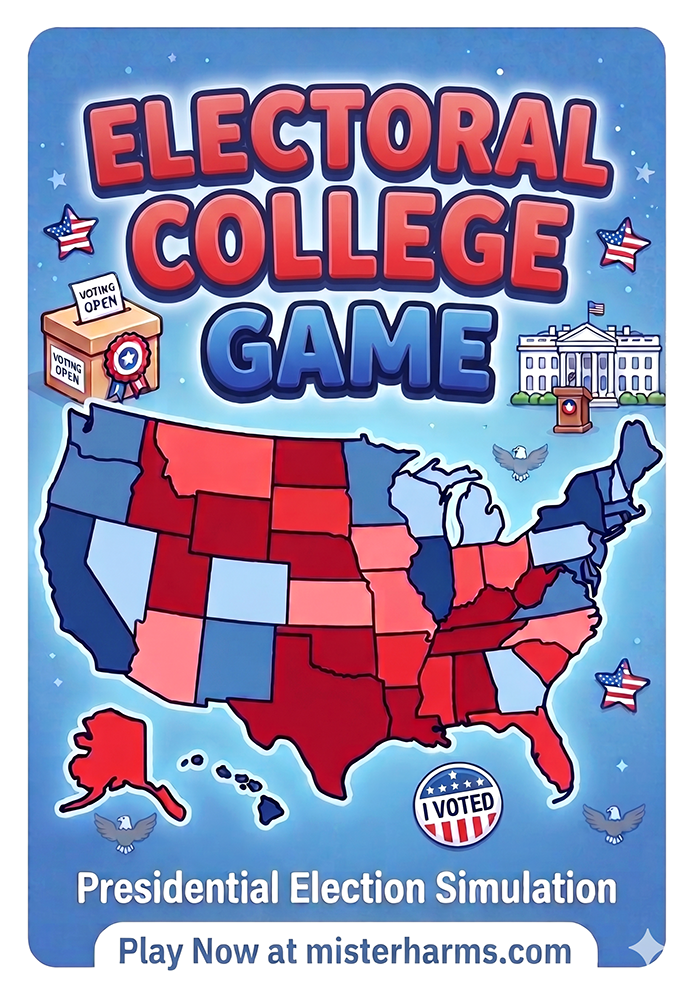
Set Your Campaign: Choose "Player vs Player" to battle a classmate, or "Player vs Computer" to test your strategy against the AI. Enter your candidate or party names.
Choose Your Colors: Select from 10 different party colors.
Enable October Surprises: Toggle "Campaign Play" to introduce random, real-world political events (like debate gaffes or celebrity endorsements) that alter your dice rolls.
Run Your Campaign: Take turns selecting states on the interactive map. Both players roll the dice, and the highest roll wins that state's electoral votes.
Race to 270: Watch the progress bar fill up. The first candidate to reach 270 Electoral Votes wins the presidency!
The House Tie-Breaker: If the map ends in an exact 269-269 tie, the 12th Amendment is triggered. The game shifts to a House of Representatives vote where each state gets exactly one vote!
This election simulator is designed to be a frictionless, zero-prep addition to any civics, government, or election unit. Here are a few highly engaging ways to utilize the Race to 270 game with your students:
Partner Match-Ups (1-on-1): Utilize the "Player vs Player" mode by pairing students up on a single device. Have them create custom party names and compete directly. This naturally highlights the strategic importance of swing states versus safe states as they battle for the highest electoral yields.
Independent Practice: Have students utilize the "Player vs Computer" mode as an independent activity or station rotation. It is a great way for them to solidify their understanding of state geography, electoral weights, and the math required to reach the 270 threshold.
Whole-Class Smartboard Challenge: Project the game onto your classroom interactive board. Divide the room into two campaign teams, allowing students to take turns coming to the front to select target states, roll the dice, and cheer on their "campaign."
The "October Surprise" Discussion: Use the Campaign Play mode to spark critical thinking about real-world election dynamics. When a random event triggers, pause the game to discuss with the class how media coverage, debate gaffes, and endorsements actively impact voter turnout and polling.
Looking to take this lesson offline or expand your unit? Add these trusted resources to your teacher toolbox:
The Printable Election Simulator Worksheet Game: Want a hands-on, screen-free alternative? Grab the physical, printable version of this simulation, complete with tabletop dice mechanics, tally sheets, and blank maps.
Teaching the Presidential Election: Dive deeper into election mechanics with a complete breakdown of curriculum bundles, lesson plans, and actionable teaching strategies on the blog.

The Presidential Election is always an exciting time for students. As students watch the Democratic Party candidate and Republican Party candidate campaign to become President, teachers love the opportunity to join in the intrigue and successfully teach about the political process.
One common unknown in this race for the White House, is the mysterious electoral college. Many students are surprised to hear that the President is not necessarily the candidate with the most popular votes, but rather the candidate who wins the most electoral votes.
I have been teaching for many years and have found that this resource actively engages students in learning about the electoral college. This concept of government can certainly be limited to upper level courses, but it doesn't have to be. This resource does a great job of providing a fun competition to guide the learning process of how the electoral college system works and why it is a valid way to elect the president.
This lesson has been a time-tested, teacher-approved success for all of my classes! From elementary through high school, you will find that students love the competition and learning about a complex system they were completely unaware of. I know you will love learning about the electoral college using this fun and engaging game resource!
⭐️ Also available on Teachers Pay Teachers
⭐️ Follow Mister Harms for new releases, updates, and sales!
⭐️ Learn more on my Electoral College Map Game blog post!
🕹️ Play the online Electoral College Game
Complete set of teacher instructions and game play rules to help guide in preparation and implementation.
Two sets of game play rules. You can choose either way to play the game.
A worksheet with a map of the United States that includes the number of electoral votes for each state.
A game scorecard for students to document the states and electoral votes won.
A set of reflection questions for student partners to complete and discuss.
Game dice are not included in this download!
"This was ridiculously fun! Students requested to play it again, long after the election had passed. Will definitely use it in the future! Thank you!" - Sciulli ★★★★★
⭐️ Read more on my electoral college blog post
⭐️ Get the Civics & Government Bundle and save
Thanks so much for stopping by. It's great to meet you! I hope this resource adds value to your classroom. I would also love to see how you've incorporated this product into your classroom. Feel free to post a photo of this resource in action and tag @misterharms so I can meet you!
The Race to 270 refers to the 270 electoral votes a presidential candidate must secure to win a majority of the 538 total votes in the United States Electoral College system.
Through a U.S. map and dice rolls in this president simulator, students simulate a real election and learn how the electoral votes from each state determine the next president of the United States!
If no candidate reaches 270 votes (like a 269-269 tie), the 12th Amendment requires the House of Representatives to decide the election in a process called a Contingent Election. In this scenario, each state delegation casts exactly one vote, and the winner must secure a majority of 26 states.
Yes! This interactive map game simplifies the complex mechanics of the U.S. election system into an engaging, gamified simulation perfect for social studies and civics students.
Yes! Download a free electoral map study guide that includes the latest map with accurate electoral votes for each state.
Get the Printable Game Version and play in the classroom or at home with real dice and crayons! It’s classroom favorite!
Explore more election related lessons on the Mister Harms blog
Explore the Mister Harms Games Gallery for more interactive game challenges and civics activities. Or, browse my Teacher Store for complete lesson plans and resources trusted by over 100,000 educators.
Make civics practical and exciting for students using this Social Studies simulation that allows students to experience the Legislative Branch! Students will participate in writing bills for their school, community, or state while learning the various stages within the lawmaking process. All voices are heard as students become members of Congress, participate in committees, debate on the floor, and watch their President sign the bills that survive the entire process. Not only do students love this simulation, they are actually learning the stages of how a bill becomes a law.
⭐️Save 20% on this product & other civics resources by purchasing the bundle! Click here.⭐️
This Legislative Branch Simulation has become one of the highlights in my government class. Students love the opportunity to write bills in hopes of influencing their school, community, or state. Once a bill has passed through the entire process, many of the students' bills can actually change school policy. Our school has had numerous changes due to my 8th grade bills that became law (water bottle fountains, locker room changes, school course offerings, etc.). Learning about the law-making process is good, but actively being engaged in the process is great! You may also like my Legislative Branch Notes to help your students better understand how the Legislative Branch operates and is organized.
Now available in Google Drive format!
Detailed teacher directions explaining how to run the simulation
Student handout with directions explaining the simulation
Templates for students to write their own bills (PDF or Google Drive)
Scoring sheet for student progress (PDF or Editable Google Drive Version)
Sample bills to help explain how students should write bills
Everything you need is included! NO PREP! Just print and go!
"This activity was amazing! Both my students and myself thoroughly enjoyed this simulation activity. I cannot wait until I am able to use it again. Thank you so much!" - Jazmin ★★★★★
⭐️ Read more about this resource on my blog
Thanks so much for stopping by. It's great to meet you! I hope this resource adds value to your classroom. I would also love to see how you've incorporated this product into your classroom. Feel free to post a photo of this resource in action and tag @misterharms so I can meet you!
The Presidential Election is an exciting time that happens every four years! The two major Political Parties, Democratic and Republican, get to debate their beliefs to influence voters! What is a political party anyway? What is the difference between Democrats and Republicans? Am I a Democrat or Republican? These are common questions that all students begin to ask themselves, and this political parties lesson plan will help answer all their burning questions!
I have been teaching for many years and have struggled to find a resource that helps students truly understand what the differences are between the two major parties. Many students think of themselves as Democrat or Republican based upon the personalities of popular candidates. They also shape their stances based upon their pre-conceived, family beliefs. I created this lesson to help my own students understand what the parties actually stand for and to help students decide what party they most align with based upon the political issues. It has definitely become a fan favorite with my students, and I look forward to this lesson every year!
This lesson has been a time-tested, teacher-approved success for all of my classes! Students will learn about the beliefs behind the parties by looking at the terms liberal and conservative on a visual spectrum. Parties are just names given to groups of people that think similarly about how the role of government should be. By looking at a spectrum, those who think the government should be more liberal in its governing tend to lean toward the left and belong to the Democratic Party. Those who think the government should be more conservative in its governing tend to lean toward the right of the spectrum and belong to the Republican Party.
"This was perfect when I taught the election. Loved how it was an accurate way to teach about the different party views in a neutral, non-biased way and my students loved it too!" - Gabrielle ★★★★★
Students will learn through a guided set of notes followed by a worksheet that will ask students if they agree or disagree with certain political statements. This worksheet will provide a foundation for a lively classroom discussion as well as a baseline to help students know which party they most align with. As real-life political beliefs are debated and discussed within the class, students will eventually figure out if they lean more left or right. Seeing their position on the spectrum helps students realize if they are more Democrat leaning or Republican leaning.
You and your students will love this lesson! It's hands-down the best lesson for helping students understand the real differences and issues between the political parties and their platform beliefs! Not only will students have fun, but you will be able to kick off your political parties unit with comfort knowing your class understands the fundamentals of politics! After using this lesson, Your students will love creating their own parties and campaigns using my Presidential Election Campaign Simulation!
⭐️ Read more about this resource on my blog
Complete set of instructional visuals/notes to help guide you and your students through the lesson in a Google Slideshow format.
Fully detailed set of teacher directions for you to successfully implement the lesson. You will feel well prepared to deliver an amazing lesson!
A student worksheet with 13 different political statements for students to agree or disagree with. These statements will help guide the classroom discussion as well as help determine if each student leans more liberal or conservative which will help them know if they are more Democratic or Republican.
All resources are in GOOGLE Drive format as well as PDF. You can assign in print form or assign through Google Classroom.
All resources are completely editable for you to customize as needed!
Thanks so much for stopping by. It's great to meet you! I hope this resource adds value to your classroom. I would also love to see how you've incorporated this product into your classroom. Feel free to post a photo of this resource in action and tag @misterharms so I can meet you!
The Presidential Election is always an exciting time for students. As students watch the Democratic Party candidate and Republican Party candidate campaign to become President, teachers love the opportunity to join in the intrigue and successfully teach about the political process.
One common unknown in this race for the White House, is the mysterious electoral college. Many students are surprised to hear that the President is not necessarily the candidate with the most popular votes, but rather the candidate who wins the most electoral votes.
I have been teaching for many years and have found that this resource actively engages students in learning about the electoral college. This concept of government can certainly be limited to upper level courses, but it doesn't have to be. This resource does a great job of providing a fun competition to guide the learning process of how the electoral college system works and why it is a valid way to elect the president.
This lesson has been a time-tested, teacher-approved success for all of my classes! From elementary through high school, you will find that students love the competition and learning about a complex system they were completely unaware of. I know you will love learning about the electoral college using this fun and engaging game resource!
⭐️ Also available on Teachers Pay Teachers
⭐️ Follow Mister Harms for new releases, updates, and sales!
⭐️ Learn more on my Electoral College Map Game blog post!
🕹️ Play the online Electoral College Game
Complete set of teacher instructions and game play rules to help guide in preparation and implementation.
Two sets of game play rules. You can choose either way to play the game.
A worksheet with a map of the United States that includes the number of electoral votes for each state.
A game scorecard for students to document the states and electoral votes won.
A set of reflection questions for student partners to complete and discuss.
Game dice are not included in this download!
"This was ridiculously fun! Students requested to play it again, long after the election had passed. Will definitely use it in the future! Thank you!" - Sciulli ★★★★★
⭐️ Read more on my electoral college blog post
⭐️ Get the Civics & Government Bundle and save
Thanks so much for stopping by. It's great to meet you! I hope this resource adds value to your classroom. I would also love to see how you've incorporated this product into your classroom. Feel free to post a photo of this resource in action and tag @misterharms so I can meet you!
To better understand the basic information within the U.S. Constitution, students will enjoy these four lesson activities. This bundle is a great way to introduce, study, or review the United States Constitution for your civics unit or for a Constitution Day activity. Buy buying the bundle, you are getting $1 off each product worth a savings of more than 25% off the listed price!
⭐️ Read more about all of the included resources on my blog post
⭐️ Also on Teachers Pay Teachers
⭐️ Play the online Constitution Games
The Following 4 Lesson Activities Are Included in This Bundle:
Class Constitution Activity | Create your very own classroom Constitution
Constitution & Constitutional Convention Notes and Assessment
Answer keys for all worksheets are included!
Online links to access the full text of the Constitution are included.
You will receive a printable PDF version, access to a digital Google Drive worksheets, and a self corrected Google Form!
Thanks so much for stopping by. It's great to meet you! I hope this resource adds value to your classroom. I would also love to see how you've incorporated this product into your classroom. Feel free to post a photo of this resource in action and tag @misterharms so I can meet you!
To better understand the basic information within the U.S. Constitution, students will browse through this primary source document and find the main ideas regarding the 7 Articles and 27 Amendments. Included are 17 questions about the articles and 27 questions about the amendments. All questions (except for one) will be answered with a number. This is a great way to introduce, study, or review the United States Constitution for your civics unit or for a Constitution Day activity. You may even want to group your students and make this into an engaging, competitive race. Whatever method you use, your students will certainly gain a better understanding of the facts and layout of the U.S. Constitution. It's on-point, simple, and the most effective way to understand what is in this important United States document! This resource is available in printable PDF, a digital Google Drive worksheet, and a self corrected Google Forms format.
⭐️ Read more about this resource on my blog post
⭐️ Also on Teachers Pay Teachers
⭐️ Play the online Constitution Games
⭐️ Save 25% on this product by getting the Constitution Bundle
A brief set of teacher directions to help you with implementation
A quick, 3 page worksheet of scavenger hunt questions
17 questions that will analyze the original 7 articles of the Constitution
27 questions to help summarize the additional 27 amendments
Answer keys for all worksheets are included!
Online links to access the full text of the Constitution are included.
You will receive a printable PDF version, access to a digital Google Drive worksheet, and a self corrected Google Form!
Which article explains the Judicial Branch and our court systems?
According to Article II, how old must you be to become President?
Which amendment outlaws slavery?
Which amendment gives women the right to vote?
And more.....
A copy of the U.S. Constitution is not included in this product. You will want to use the Constitution found in your textbook or another source. This "Constitution Scavenger Hunt" product can be used for studying just the Articles, Amendments, or the entire document for a full overview. Each year, this method proves to be one of the best ways for my students to comprehend the information and layout of the U.S. Constitution. In addition, I also like to use Constitution: The Articles, Primary Source in my unit on the Constitution. This product goes even more in-depth on the original 7 articles of the Constitution! To introduce the Constitution, you will love this set of Notes on the Constitutional Convention! You might even want to create your very own Class Constitution! I hope you enjoy all of these resources on the Constitution. If you do, I highly recommend getting the Constitution Bundle so you can save over 25%!
☞ "I used this as a review two days before my students took a US Civics test and they said it really helped them remember the ins and outs. Concise and to the point without overwhelming!" - Delaynie ★★★★★
Thanks so much for stopping by. It's great to meet you! I hope this resource adds value to your classroom. I would also love to see how you've incorporated this product into your classroom. Feel free to post a photo of this resource in action and tag @misterharms so I can meet you!
Have you ever created a constitution for your own classroom? Each year in civics class, as we learn about the United States Constitution, I have my students help create our very own class constitution. The students love being a part of creating rules and policy for our classroom. This student-led activity has always proven to be a success! Each student's voice is heard as they actively engaged in crafting of an official document for the class. The process begins as students are grouped to draft goals and purposes in the form of a preamble. Once the preamble is approved, students give voice to a variety of articles that should be included in the constitution. When complete, all students will ratify and sign the big document!
⭐️ Save 25% on this product by getting the Constitution Bundle!
⭐️ Read more about this resource on my blog post
Your students will have fun with this entire learning process. Not only will they better understand what a constitution is and how a constitution works, but you will now have an official, student created document to guide your classroom. I have always found this activity to be an academic success, and a great way to improve classroom behavior as well. You will even find students holding you accountable to their constitution! After 10 years of teaching this lesson, I've worked out the bugs for you to have a successful implementation. Even though I use this for my Civics class, you can certainly use this activity for any subject matter. Making a constitution can be fun and rewarding for all classrooms! Enjoy, you'll love it!
What’s Included:
3 pages of detailed teacher directions that explains the entire process
A full sample template of my classroom's constitution for content ideas
A link to access an editable, GOOGLE Drive version of my constitution to make it your own
Pictures of my completed and signed classroom constitution to help you see the finished product
“I found this resource to be very helpful- I knew I wanted the students to make a class constitution but I wanted it to have good structure and direction. This was perfect because of the clear instructions for me as the teacher and the example class constitution included was also helpful.” - Merrisah ★★★★★
Thanks so much for stopping by. It's great to meet you! I hope this resource adds value to your classroom. I would also love to see how you've incorporated this product into your classroom. Feel free to post a photo of this resource in action and tag @misterharms so I can meet you!
Make civics informative and practical for your students by using this set of notes and assessments that summarize the main points of the Legislative Branch! I have used this set of notes regarding the Legislative Branch in my 8th grade civics class for many years. This branch of government, which is the largest, can be daunting to summarize and teach. However, I have narrowed down the important aspects so students get the main concepts and you’ll get a complete unit of notes on the Legislative Branch. Even though I use this resource for my 8th grade class, I would highly recommend these notes for grades 7-12 as the information is pertinent for any Civics or Government class! For the upper level courses, you may choose not to use the fill-in-the-blank style notes.
⭐️ Save 25% on this product and other civics resources by purchasing the bundle!
What's Included:
20 slides of content-rich information explaining the Legislative Branch.
4 pages of guided, fill-in-the-blank notes for students to stay engaged while listening to teacher instruction.
3 page assessment worksheets to be used as group work, homework, or a summary test. Assessment includes critical thinking questions, matching, True & False, How a Bill Becomes A Law, etc..
All notes and worksheets are in Google Drive Format and are completely editable for your classroom needs. Feel free to add, subtract, or revise as desired.
Notes have picture spots for your senators and representatives as well as a few video links that summarize the legislative process.
All notes and assessment content covers the major aspects of the Legislative Branch. Topics included are: Summary of, Organization of, Committees, Leadership, Legislative and Non-Legislative Powers, How A Bill Becomes A Law, Presidential Involvement, etc...
Additional Content:
I like to use this set of notes intermittently throughout my Legislative Branch Simulation! By using these notes along-side my Legislative Branch Simulation, students not only learn the content, but enjoy the process as well. This set of tag-team resources helps bring variety to the unit as well as reaching all learning styles. It's a great way to learn about the Legislative Branch of government without getting monotonous! I highly recommend jumping back and forth between this set of notes and my Legislative Branch Simulation! Your students will thank you too!
⭐️ Read more about this resource on my blog
Thanks so much for stopping by. It's great to meet you! I hope this resource adds value to your classroom. I would also love to see how you've incorporated this product into your classroom. Feel free to post a photo of this resource in action and tag @misterharms so I can meet you!
What does the President of the United States do anyway? Throughout the day, the President wears many hats and is responsible for many different roles within the Executive Branch. This engaging mini-lesson is an excellent way for students to comprehend all roles played by the President.
"Roles of the President" is an engaging resource for any unit that studies the President or the Executive Branch. The 7 roles studied include: Chief Executive, Chief Diplomat, Commander in Chief, Party Chief, Economic Chief, Legislative Leader, & Head of State.
⭐️ This product is also included in my Presidents Bundle - Save over 20%
What's Included:
Now includes an additional Google Drive version and/or a Google Forms version to assign in Google Classroom.
Complete set of instructional directions for the teacher
Two page student reading that explains the seven major roles played by the President. Each role has a summary explanation along with several specific examples
Directions for skits as students will explain each role through acting out scenarios
Assessment with 14 questions that reads like a story, explaining a day in the life of the President. As the story reads, scenarios are underlined and students must identify what role is being played by the President. For example: "...after being briefed on the news, the President receives an urgent call from the King of Saudi Arabia to discuss plans for the upcoming peace summit involving many Middle Eastern countries...." - Students will identify which of the 7 presidential roles is being played in this scenario.
"This was a great way to teach the roles the President has and give examples of the roles being used. My students were very engaged and loved creating their skits." - Karrie ★★★★★
Thanks so much for stopping by. It's great to meet you! I hope this resource adds value to your classroom. I would also love to see how you've incorporated this product into your classroom. Feel free to post a photo of this resource in action and tag @misterharms so I can meet you!
"Let's Get The Party Started!" This presidential election simulation is an excellent way for students to comprehend all aspects of political parties and the campaigns needed to elect a presidential candidate.
The teacher will divide class into groups of 4 to 5 students per group. Each group will develop their own political party and choose a presidential candidate to represent their party. Using the included criteria, allow students a few class periods, or portions of class periods, to create, form, and practice presenting their party until election day. On election day, candidates and their political parties will present their campaigns to other classes, staff, and/or your own classroom. If desired, have all those citizens that heard the campaigns vote for the best candidate/party. Download this campaign simulation for a fun, educational lesson that your students will remember for years to come. "Lets get the party started!"
⭐️ One of the best ways to prepare your students for this simulation is to study the various aspects of a party! I like to use my lesson Political Parties Spectrum: What is a Democrat & Republican? as an introduction before we start this election campaign simulation!
⭐️ Save 25% on this product by purchasing the Civics & Government Bundle!
What's Included:
A detailed student-guided handout for creating a party name, logo, slogan, planks, platform, propaganda, presentations, etc...
Two grading rubric options
Complete teacher and student directions for running a successful presidential campaign
All pages are available in printable PDF and digital Google Drive versions!
"...I was blown away by how excited the students, parents, and other elementary grades were....The students took the assignment and were crazy-creative, invested, and begging for more time. Groups were getting together at each other's houses just to work more, new friendships were made, and our presentation day was a huge hit! This is going to be a 5th grade tradition!" - Middle School Teacher ★★★★★
⭐️ Read more about this resource on my blog
Thanks so much for stopping by. It's great to meet you! I hope this resource adds value to your classroom. I would also love to see how you've incorporated this product into your classroom. Feel free to post a photo of this resource in action and tag @misterharms so I can meet you!
The Constitutional Convention of 1787 was an important event that changed United States History. 55 Delegates gathered in Philadelphia to change the Articles of Confederation, but soon realized a new Constitution was much needed! This entire 4 month meeting, from May to September of 1787, is so important for students to understand when studying the Constitution and the foundations of the newly formed United States of America. Many teachers find this meeting intimidating to explain, but it doesn't have to be. Throughout the years I have used these notes in my 7th Grade American History classes as well as my 8th Grade Civics classes. Since these notes have been such a benefit in my own classes, I have made them available to download. I know you and your students will enjoy these notes as you learn about this important meeting!
⭐️ Save 25% on this product by getting the Constitution Bundle!
Teacher directions on how to incorporate this lesson
Slide presentation of content-rich notes explaining the details of the Constitutional Convention, the important compromises, and more...
Guided, fill-in-the-blanks notes for students to complete while taking notes
A link to a short video that explains the Convention a bit more
A reinforcement worksheet to use as an assessment which has 17 questions to help students review the basic ideas of the Constitutional Convention
Answer keys for all student notes and worksheets
I use these notes for 7th & 8th grade, but I would have no hesitation using them through grade 12. I also like to do these notes in segments while we work on other Constitutional activities during this unit.
ALL FILES ARE FULLY EDITABLE FOR YOUR PERSONAL CLASSROOM NEEDS! Add what you want. Subtract what you don't want. Change whatever you want!
All files are in GOOGLE Drive format and fully editable to meet your personal preferences. You will be given a link to access all files in GOOGLE Drive. Once accessed, you can present the notes in GOOGLE Slides or download as a PowerPoint and present as desired. The student handouts may be printed out, shared with students, or downloaded as a PDF and used as needed.
"It is my first year teaching US government, and this resource was super helpful to make sure I covered the most important content!" - Social Studies Teacher ★★★★★
⭐️ Read more about this resource on my blog post
Thanks so much for stopping by. It's great to meet you! I hope this resource adds value to your classroom. I would also love to see how you've incorporated this product into your classroom. Feel free to post a photo of this resource in action and tag @misterharms so I can meet you!

Experience the difference that 25 years in the classroom makes.
Teaching Civics shouldn't feel like a chore for you or your students. As a veteran social studies teacher, I’ve spent over two decades refining these resources to ensure they are high-interest, easy to implement, and—most importantly—effective.
This is more than just a collection of files; it’s a curated toolkit designed to turn your civics or government classroom into an active laboratory of democracy. From the high-energy of my Constitutional simulations to the streamlined clarity of my CNN 10 guides, every resource high quality with minimal distractions so students can focus on the content.
⭐️ Currently this growing bundle includes 17 civics and government related resources by Mister Harms. See the images to know which products are included. Save 20% by getting the bundle!
Why educators trust the Mister Harms approach:
Active Learning: Move beyond the textbook with simulations that actually work.
Minimalist Design: Clean, modern layouts that students enjoy looking at.
Digital & Print: Every resource is classroom-ready for both paper and Google Drive™.
A Growing Investment: When you buy this bundle, you’re "grandfathered in." Every new Civics resource I add to this bundle is also yours for free.
What’s Inside this Bundle:
The Foundations: 17 core products that deep dive into the Declaration, Preamble, and Constitution, and more. See the images to know which products are included.
The Mechanics: Interactive lessons on the various aspects of the legislative branch and lawmaking.
The Culture: Engaging activities on Citizenship, Voting, and Elections.
The Routine: My best-selling "CNN 10" and Political Parties resources to keep your classroom engaged.
A Note From My Classroom to Yours: I’m a fourth-generation teacher, and I know how precious your time is. My goal is to give you your evenings back by providing resources that are ready to go the moment you download them.
🕹️ Games Hub: Practice civics and more at the Free Games Hub
⭐️ Also available on Teachers Pay Teachers
"I wish I could be a student in this classroom. All of the resources have brought so much fun and engaging lessons." — Jennifer U. ⭑⭑⭑⭑⭑
Thank You!
Thanks so much for stopping by. It's great to meet you! I hope this resource adds value to your classroom. I would also love to see how you've incorporated this product into your classroom. Feel free to post a photo of this resource in action and tag @misterharms so I can meet you!
Want More?
Stay informed: Join the Classroom for freebies and updates!
Follow @MisterHarms: TpT | Instagram | Twitter | Pinterest | Facebook
More: Blog | Games | Store | YouTube