Legislative Branch Activity: How a Bill Becomes a Law Simulation
Quick Answer: A Legislative Branch simulation is an immersive classroom activity where students role-play as members of Congress to experience the lawmaking process firsthand. By proposing, debating, and voting on original bills, students move beyond rote memorization to understand parliamentary procedure and the complexities of how a bill becomes a law in a practical, middle or high school setting.
Let’s be honest: explaining the journey of a bill through subcommittees and floor debates can be a "dry" day in the classroom. But what if your students weren't just reading about Article I—what if they were living it? This Legislative Branch simulation transforms your room into the halls of Congress, giving students the power to change their world (or at least their school) one bill at a time.
Why Classroom Simulations Matter in Civics
Active engagement is the "secret sauce" of long-term retention. When students take on the persona of a Representative, the stakes change. They aren't just memorizing steps for a test; they are navigating checks and balances and learning the art of compromise. According to research on experiential learning, students who participate in simulations score significantly higher on critical thinking assessments than those in lecture-based environments. If you're looking for more ways to bring the classroom to life, check out these foundational Constitution activities to pair with your simulation.
This How A Bill Becomes A Law Simulation has become one of the highlights of my civics class. Students love the opportunity to influence their school, community, or state through the bills they write. Each year, a small number of my students’ bills have actually changed school policy because our wonderful school administrators have actively joined in on the participation, making sure the doable bills actually happen! Over time, my 8th grade bills have improved our school in a variety of ways: installation of water fountains with bottle fillers, new locker room changes, school course offerings, and more.
🇺🇸 For an additional reinforcement activity, your students will the iCivics Lawcraft Congress Simulation Game
Pin this for later! (Hover over the image below to save it to your "Civics Ideas" board).
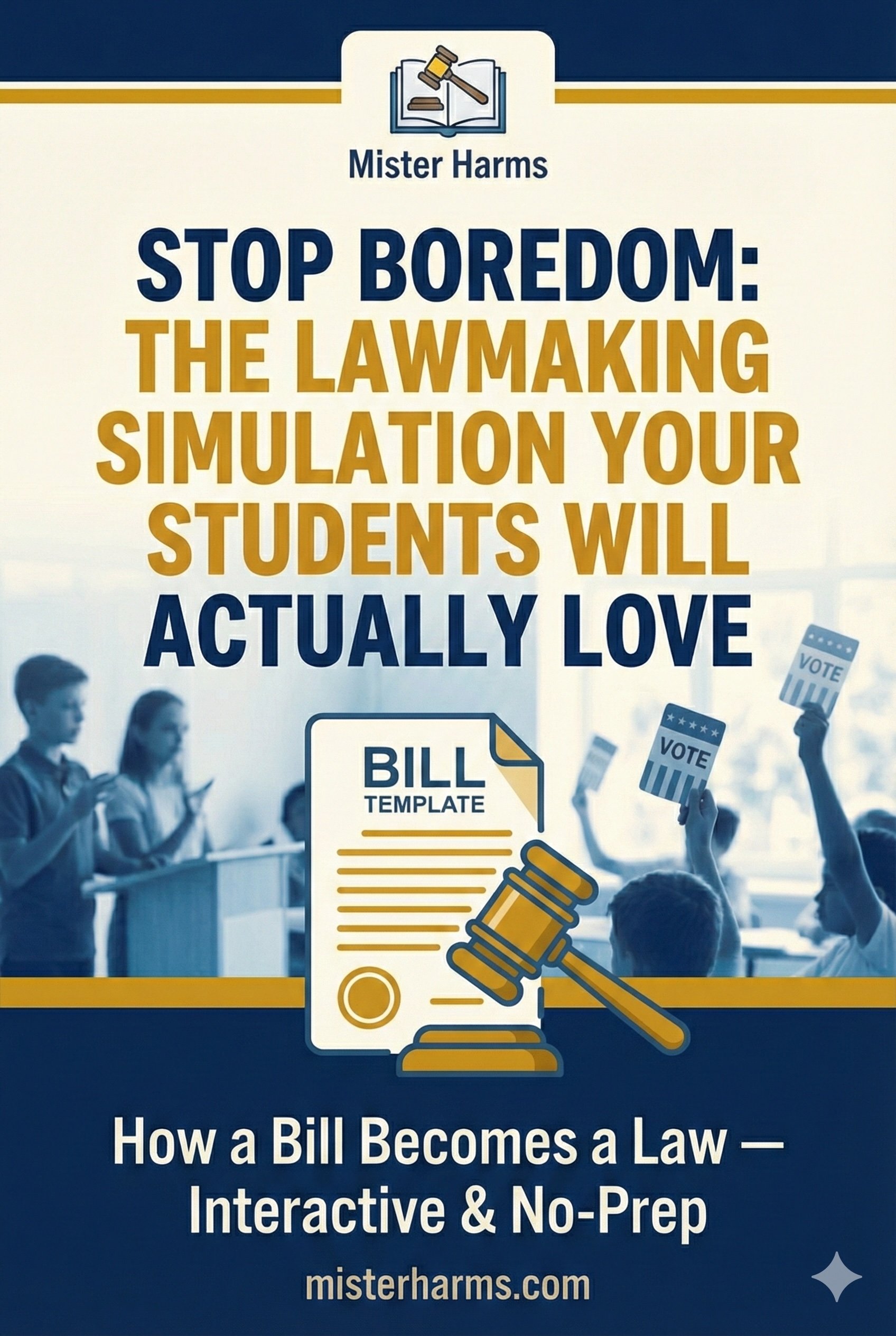
Looking for an engaging way to teach how a bill becomes a law? This Legislative Branch simulation for middle and high school civics turns students into members of Congress! 📝 Transform your government unit today. #CivicsTeacher #SocialStudies #LegislativeBranch #TeacherLife #MisterHarms
What’s Included in the Simulation Pack
This resource is a "plug-and-play" solution for busy educators. Whether you are a first-year teacher or a veteran, everything you need is ready to go:
Step-by-Step Teacher Guide: No guesswork involved.
Student Bill Templates: Formatted to look like official legislative documents.
Scoring Rubrics: Easily track student progress during debates.
Digital & Print Formats: Fully compatible with Google Drive for paperless classrooms.
How do I run a Legislative Simulation in my classroom?
What I love about this simulation is that it makes learning about the Legislative Branch very real, engaging, and even exciting. Students get to participate in writing bills for their school, community, or state while learning the various stages within the lawmaking process. In addition, all voices are heard and each student has a chance to contribute.
Every student gets to become a member of Congress, write their own bills, participate in committee discussions, debate on the house/senate floor, and eventually watch the President sign the bills that survive through the entire process. Not only will the students love this simulation, but they get a chance to change their school, and in the process, learn all the aspects of how a bill becomes a law:
The Proposal: Students identify a real-world problem in their school or community. I often have my students browse Congress.gov to see what actual bills are currently being debated to get their creative juices flowing. Then, they draft their own version using the provided templates.
Committee Work: Bills are "sent to committee" where small groups debate, edit, and decide which bills move to the floor.
The Floor Debate: The class acts as a full legislative body. Use parliamentary procedures (like "I move to...") to keep things professional and orderly.
Presidential Action: You (or a student) act as the President to sign or veto the final products.
Frequently Asked Questions
How much class time does this take?
Most teachers find that 3 to 5 class periods is the "sweet spot" to allow for thoughtful bill writing and robust floor debate without losing momentum. It can also be used effectively throughout an entire quarter.
Can I use this for homeschool or small groups?
Absolutely. While a full class provides more voices, a small group can focus on the committee process and research. It’s easily adaptable for any group size.
Is this aligned with C3 Framework standards?
Yes! This activity directly supports C3 Framework standards for Civics, specifically focusing on the roles and responsibilities of government officials and the lawmaking process.
⭐️ The Bottom Line: If you want your students to walk away with a deep, personal understanding of the Legislative Branch, this simulation is your best tool.
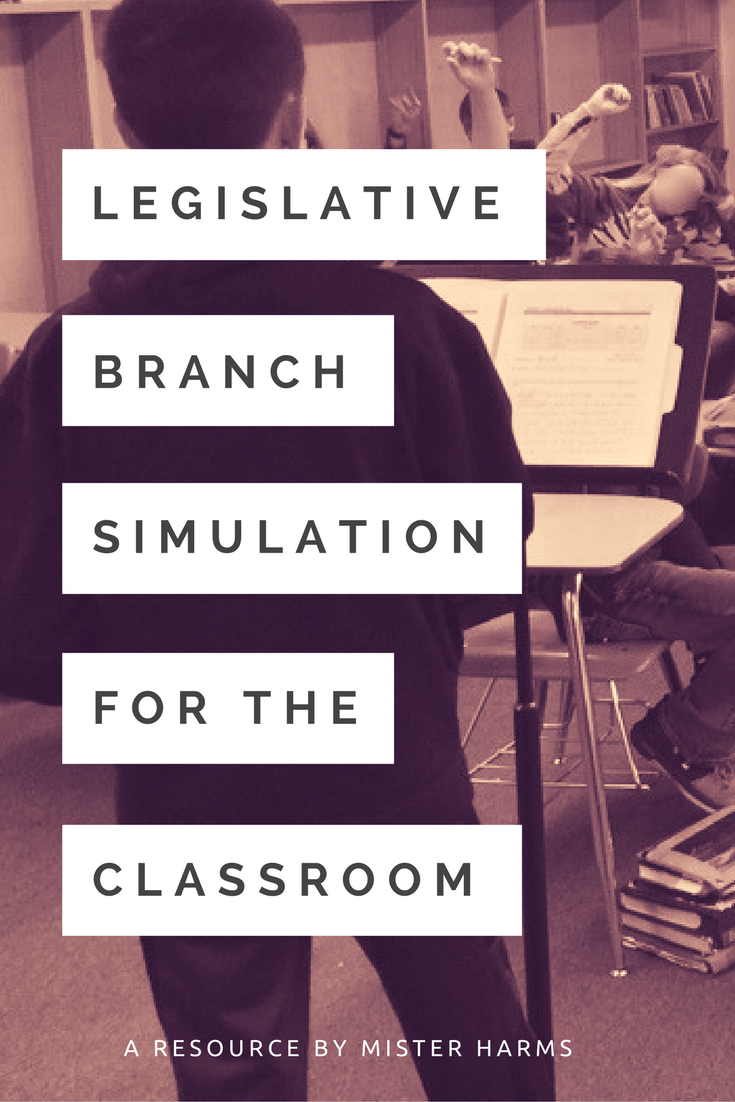
Students holding a discussion in an engaging legislative branch simulation activity for middle school or high school government classes.
“This Legislative activity was amazing! Both my students and myself thoroughly enjoyed this simulation. I cannot wait until I am able to use it again. Thank you so much! ”
HOW A BILL BECOMES A LAW IN YOUR CLASSROOM
Learning about the legislative branch and lawmaking process is good, but actively being engaged in the process is great!
I know you will enjoy this hands-on simulation as you incorporate it within your civics and government classes. It has proven to be a fantastic means of making the legislative branch come to life!
For more content information to add to your legislative branch simulation, you may also be interested in my Legislative Branch Notes and Worksheet Assessment. These notes and worksheets help explain the details of the United States legislative branch.
What other engaging activities and lessons have you incorporated into your civics classes? Comment below and share your expertise.
⭐️ Join my classroom for future email updates and get 10% off! ⭐️
Make civics practical and exciting for students using this Social Studies simulation that allows students to experience the Legislative Branch! Students will participate in writing bills for their school, community, or state while learning the various stages within the lawmaking process. All voices are heard as students become members of Congress, participate in committees, debate on the floor, and watch their President sign the bills that survive the entire process. Not only do students love this simulation, they are actually learning the stages of how a bill becomes a law.
⭐️Save 20% on this product & other civics resources by purchasing the bundle! Click here.⭐️
This Legislative Branch Simulation has become one of the highlights in my government class. Students love the opportunity to write bills in hopes of influencing their school, community, or state. Once a bill has passed through the entire process, many of the students' bills can actually change school policy. Our school has had numerous changes due to my 8th grade bills that became law (water bottle fountains, locker room changes, school course offerings, etc.). Learning about the law-making process is good, but actively being engaged in the process is great! You may also like my Legislative Branch Notes to help your students better understand how the Legislative Branch operates and is organized.
What's Included In This Legislative Branch Lesson Plan About How A Bill Becomes A Law Game:
Now available in Google Drive format!
Detailed teacher directions explaining how to run the simulation
Student handout with directions explaining the simulation
Templates for students to write their own bills (PDF or Google Drive)
Scoring sheet for student progress (PDF or Editable Google Drive Version)
Sample bills to help explain how students should write bills
Everything you need is included! NO PREP! Just print and go!
"This activity was amazing! Both my students and myself thoroughly enjoyed this simulation activity. I cannot wait until I am able to use it again. Thank you so much!" - Jazmin ★★★★★
⭐️ Read more about this resource on my blog
Thank You!
Thanks so much for stopping by. It's great to meet you! I hope this resource adds value to your classroom. I would also love to see how you've incorporated this product into your classroom. Feel free to post a photo of this resource in action and tag @misterharms so I can meet you!
Want More?