Teaching Bitcoin in Economics Class: A Complete Lesson Plan on the Evolution of Money, Blockchain, and Cryptocurrency
In today's rapidly changing financial landscape, where Bitcoin is being adapted at an incredible pace, understanding cryptocurrency isn't just for investors—it's essential for financial literacy. As an educator, you're preparing students for a world where digital currencies like Bitcoin are reshaping economies.
That's why I've created the Understanding Bitcoin and Money Lesson Plan — a ready-to-use resource available on misterharms.com or Teachers Pay Teachers. This blog post dives into why teaching Bitcoin matters, how to implement this lesson seamlessly in your middle or high school economics class, and its easy applications for homeschoolers and traditional teachers alike.
Whether you're a Bitcoin enthusiast fascinated by its decentralized revolution or a school teacher looking to make financial literacy engaging, this lesson bridges the gap. It highlights Bitcoin's core ideas—like scarcity, blockchain security, and peer-to-peer transactions—while keeping content accessible for grades 6-12.
Why Teaching Bitcoin and the Evolution of Money is Important in Today's Classroom
Bitcoin isn't just a buzzword; it's a pivotal chapter in the evolution of money. Created in 2009 by the pseudonymous Satoshi Nakamoto, Bitcoin introduced the world to cryptocurrency—a digital money system that's decentralized, meaning no single bank or government controls it. With a fixed supply capped at 21 million coins, it embodies scarcity, much like gold did in historical economies. For Bitcoin enthusiasts, this represents a hedge against inflation and a step toward financial sovereignty.
But for educators, the real value lies in teaching broader concepts. Students learn the six characteristics of good money: scarcity, durability, divisibility, portability, recognizability, and fungibility. They explore how societies evolved from barter systems (trading goods directly) to commodity money (like shells or gold), then to fiat money (government-backed currencies like the U.S. dollar), and now to digital innovations like Bitcoin.
In an era where the majority of young Americans are interested in crypto, this knowledge builds critical thinking. It addresses real-world questions: Why does money have value? How does blockchain—a public, tamper-resistant ledger—secure transactions? Why Bitcoin over traditional fiat currencies? By discussing pros (global transfers without banks, potential store of value) and cons (price volatility, technical storage needs), students gain balanced perspectives on technology's role in society.
For homeschoolers and public school teachers, this lesson aligns with financial literacy standards, fostering skills like economic analysis and debate. It's about equipping future leaders to navigate a digital economy.
Summarizing the Bitcoin Lesson Plan: What's Included?
This no-prep economics resource is designed for busy teachers like you. It includes:
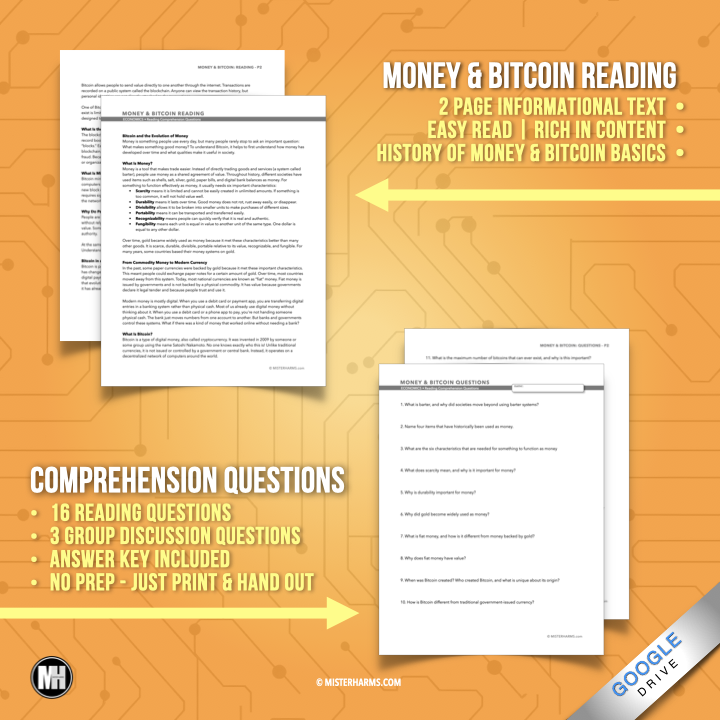
Informational Reading Passage: A 2-page, student-friendly article on "Bitcoin and the Evolution of Money," covering barter to fiat, Bitcoin's origins, blockchain, mining, and its broader context.
Comprehension Worksheet: 16 targeted questions plus 3 discussion prompts to reinforce key ideas, with an answer key for quick grading.
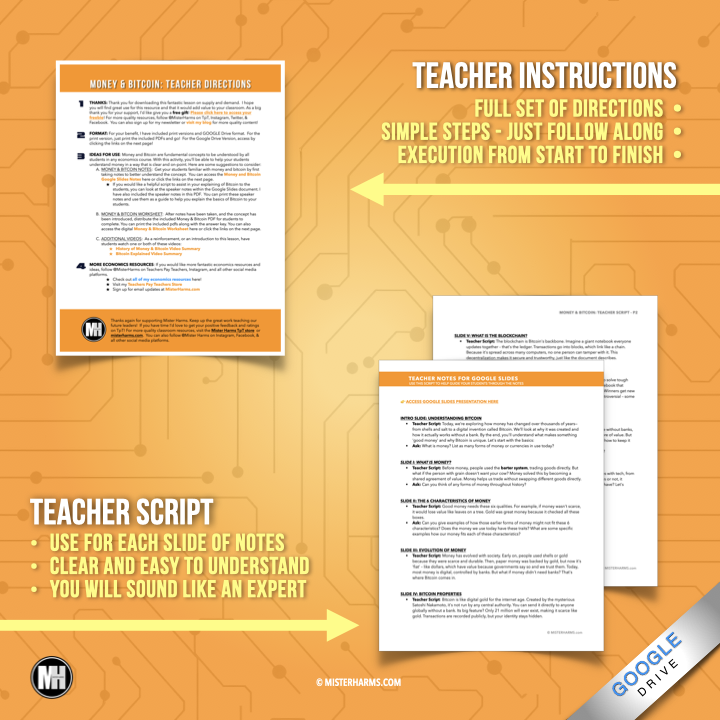
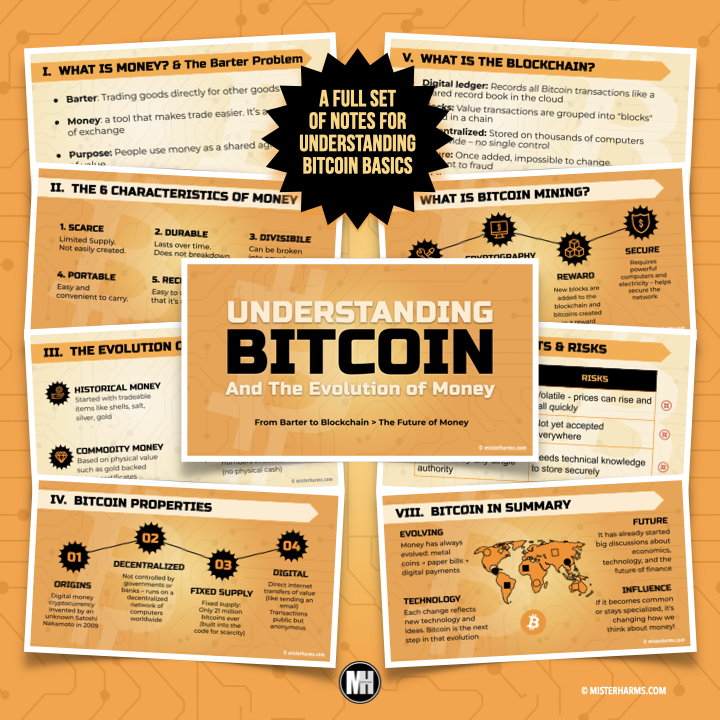
Google Slides Notes and Teacher Script: A full presentation with speaker notes to guide your explanations—perfect for introducing concepts like decentralization without needing expert knowledge.
Digital and Print Formats: PDFs for printing and Google Drive links for seamless integration into Google Classroom or hybrid learning.
Enrichment Ideas: Suggestions like watching Bitcoin explainer videos or a "Create-A-Currency" project to extend learning.
Everything is classroom-tested, requiring no prior Bitcoin expertise from you or your students.
How to Implement This Bitcoin Economics Lesson in Your Class
Implementing this lesson is straightforward, taking 1-2 class periods (45-90 minutes each). Here's a step-by-step guide based on the included teacher directions:
Introduce the Concept (10-15 minutes): Start with the Google Slides presentation. Use the teacher script to explain money's basics—ask students: "What is money? List forms in use today." This hooks them by connecting to everyday experiences like using debit cards (already digital money!).
Guided Notes and Reading (20-30 minutes): Have students take notes on the slides, then distribute the reading passage. They learn how gold met money's characteristics better than shells, why fiat money relies on trust, and Bitcoin's unique features like its 21-million cap for scarcity.
Worksheet and Discussion (20-30 minutes): Students complete the comprehension questions independently or in pairs. Follow with group discussions on prompts like: "Is decentralized money good? How will technology change money in the future?" This encourages critical thinking for Bitcoin enthusiasts and practical insights for all.
Enrichment and Reinforcement (Optional Extension): Assign the "Create-A-Currency" project or show short videos on Bitcoin's history. For homeschoolers, this works great as a family activity—discuss real-life applications like sending money globally without fees.
Adapt for different settings: In a traditional classroom, use it for sub plans or unit reviews. For homeschooling, integrate it into weekly economics sessions with hands-on elements like designing a family currency.
Easy Applications for School Teachers and Homeschoolers
This lesson's flexibility makes it ideal for any middle school or high school classroom. For middle school economics, focus on basic characteristics of money to build foundational knowledge. In high school financial literacy classes, dive deeper into blockchain and mining debates, appealing to tech-savvy teens.
Ready to bring the evolution of money and Bitcoin into your classroom? Download the full lesson plan on Teachers Pay Teachers today. Follow @MisterHarms for more economics resources, and let's empower the next generation with financial smarts!